
Aristocrats
The deck that wants its creatures dead
Picture the board wipe resolving. Three opponents sigh, you shrug, and then you start counting: nine creatures died, two of them were Blood Artist and Zulaport Cutthroat, and every opponent just lost eighteen life. That is an Aristocrats deck. It treats its own creatures as fuel, and it is named, with a wink, for the Falkenrath Aristocrat and Cartel Aristocrat cards that sacrificed a creature for a benefit.


Every other creature deck fears removal. Aristocrats shrugs at it, because a creature dying is the plan. Destroy a creature in response to its sacrifice and you have done the aristocrat's work for them. Wipe the board and you have handed them the biggest turn of the game. That inversion, where the opponent's best answers become your triggers, is what the archetype is about.
As of November 8, 2026, ArcaneMetriX classifies 531 Commander-legal cards as Aristocrats payoffs. The lists on this page are generated from that classification and refreshed with every deploy.
Three roles, one loop
An Aristocrats deck is a machine with three parts. Miss one and it is a pile of small creatures.
Fodder
Creatures that are cheap to lose: tokens, creatures that come back (Reassembling Skeleton, Gravecrawler), creatures that leave something behind when they die. Quantity over quality. A deck that makes three tokens a turn never runs out of things to sacrifice.


Outlets
The things that let you sacrifice on demand, ideally for free and at instant speed: Viscera Seer, Ashnod's Altar, Phyrexian Altar, Goblin Bombardment. A free outlet means removal can never hit what you want to keep, because you sacrifice it in response and collect the trigger.


Payoffs
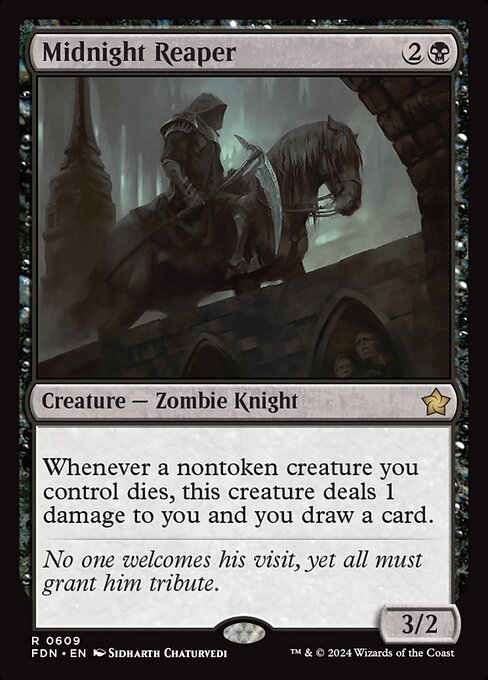
Cards that turn a death into something: life drained from each opponent (Blood Artist, Zulaport Cutthroat), cards drawn (Midnight Reaper), mana (Pitiless Plunderer), or a forced sacrifice at every other seat (Grave Pact). Two payoffs out and every death counts twice.


How hard does the table get drained?
The maths behind the archetype is simple and brutal: deaths times payoffs. What makes it a deck is that both numbers grow at once. Set a turn up here and watch what each extra payoff does.
Commanders that lead it
The best Aristocrats commanders are themselves a payoff or an outlet, so the loop is never missing a piece. Ordered by how widely played each card is across all Commander decks, not by how often it appears in this archetype. Click a card to open it in ArcaneMetriX.


Key payoffs
Cards whose main purpose, as the engine reads them, is to reward a creature dying.
-
Blood Artist -
Pitiless Plunderer -
Zulaport Cutthroat -
Viscera Seer -

Warren Soultrader -

Mondrak, Glory Dominus -

High Market -

Treasure Vault -
Grave Pact -

Carrion Feeder -

Elas il-Kor, Sadistic Pilgrim -

Altar of Dementia
Sacrifice outlets
The cards that let you choose when a creature dies. Free and repeatable is the standard; everything else is a compromise.


Combos the archetype falls into
An outlet, a creature that keeps coming back and a payoff is already a loop, which is why Aristocrats decks find infinite combos almost by accident. These are the most popular two- and three-card combos that include one of the archetype's payoffs.
-
Gravecrawler + Phyrexian Altar Infinite death triggers; Infinite creature ETB; Infinite creature LTB Commander SpellbookGravecrawlerPhyrexian Altar
-
Ashnod's Altar + Pitiless Plunderer + Reassembling Skeleton Infinite colorless mana; Infinite death triggers; Infinite creature ETB Commander SpellbookAshnod's AltarPitiless PlundererReassembling Skeleton
-
Chatterfang, Squirrel General + Pitiless Plunderer Infinite artifact ETB; Infinite artifact LTB; Infinite artifact sacrifice triggers Commander SpellbookChatterfang, Squirrel General
 Pitiless Plunderer
-
Blood Artist + Gravecrawler + Warren Soultrader Infinite death triggers; Infinite creature ETB; Infinite lifegain triggers Commander SpellbookBlood ArtistGravecrawlerWarren Soultrader
-
Carrion Feeder + Mikaeus, the Unhallowed Infinite +1/+1 counters on a creature; Infinite creature ETB; Infinite creature LTB Commander SpellbookCarrion FeederMikaeus, the Unhallowed

-
Food Chain + Squee, the Immortal Infinite colored mana that can only be spent to cast creature spells; Infinite creature ETB; Infinite creature LTB Commander SpellbookFood Chain
 Squee, the Immortal

Combo data from Commander Spellbook, the community combo database, used with credit; each entry links to its page there. ArcaneMetriX picks the combos that include one of the archetype's most-played payoffs.
Building it
Count roles, not cards. A working list has at least eight free outlets, a dozen payoffs, and more fodder than you think you need, with the rest of the deck spent on card draw that triggers off death too. The common mistake is loading up on payoffs and having nothing to sacrifice when the first one resolves. The second is paying mana for every sacrifice: an outlet that costs two each time is a tempo loss, not an engine.
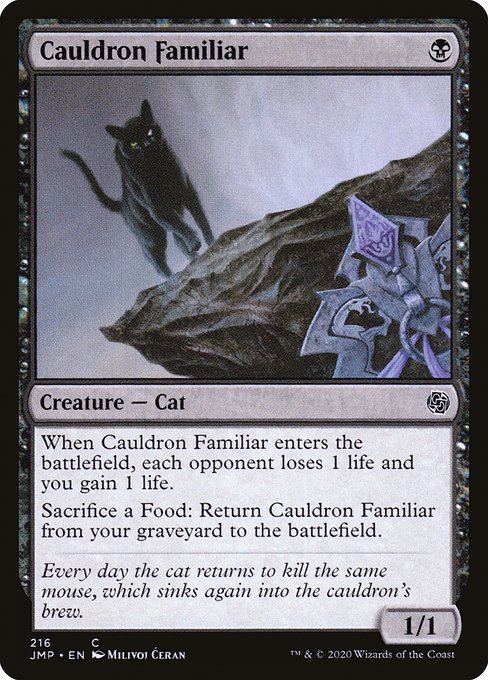
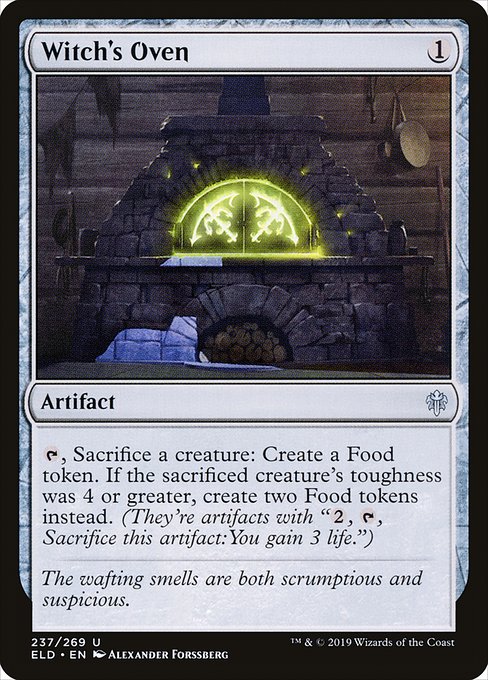
In sixty-card formats the archetype is leaner and faster: Pioneer and Modern versions lean on Cauldron Familiar and Witch's Oven, a single two-card loop that drains a life a turn and never stops. The Commander version is wider and slower and ends games in one turn rather than over twenty.
See your loop before you shuffle
Paste an Aristocrats list into ArcaneMetriX and the Synergies tab draws the outlet, fodder and payoff edges between your cards, so a missing role shows up as an empty corner of the graph rather than a lost game.
Questions players ask about Aristocrats
What is an Aristocrats deck?
A deck built around sacrificing its own creatures for value. Sacrifice outlets let you choose when a creature dies, payoffs like Blood Artist and Zulaport Cutthroat turn each death into life drained from opponents or cards drawn, and cheap fodder keeps the outlets fed.
Why is it called Aristocrats?
After Falkenrath Aristocrat and Cartel Aristocrat from the Innistrad and Return to Ravnica era, both of which sacrificed a creature for a benefit. A Standard deck built around them took the name and it stuck to the strategy.
Is Aristocrats a combo deck?
It can be. An outlet, a payoff and a creature that returns from the graveyard form a loop, so most Aristocrats decks can go infinite, but many are built to grind value with the same pieces instead. How far the deck leans into the loops decides its Commander bracket.
What colors are Aristocrats decks?
Black is the core, with the most payoffs and recursion. White adds token makers and drain, red adds free outlets like Goblin Bombardment and damage payoffs, and green adds fodder. Orzhov, Rakdos and Mardu are the classic shells.
How do I beat an Aristocrats deck?
Exile effects and graveyard hate, not destroy effects. Removing the outlets stops the loop, and killing the payoffs in response to a sacrifice denies the trigger. Board wipes are the worst answer: every creature dying is the aristocrat's best turn.